Gatsby vs Next.js: Which Framework Is Best?

Choosing a React framework used to mean weighing Gatsby against Next.js as near-equals. That calculus has shifted. Since Netlify acquired Gatsby in 2023 and subsequently laid off most of its core team, the framework has entered maintenance mode with no new features planned. For teams evaluating frameworks today, the decision is less a debate and more a matter of understanding what Gatsby still does well for existing projects, and where Next.js has pulled decisively ahead.
This article breaks down how each framework works, where each still makes sense, and what your team should factor in before committing to either.
What is GatsbyJS?
The Gatsby framework is a React-based, GraphQL-powered frontend framework that generates static HTML (Hypertext Markup Language) in advance. It is known for fast page loads through static site generation (SSG), asset optimization, data prefetching, and code splitting.
How does Gatsby work?
Gatsby fetches data and content through external APIs. It structures that data in predefined page templates, allowing pages to be rendered ahead of time to improve performance and core web vitals.
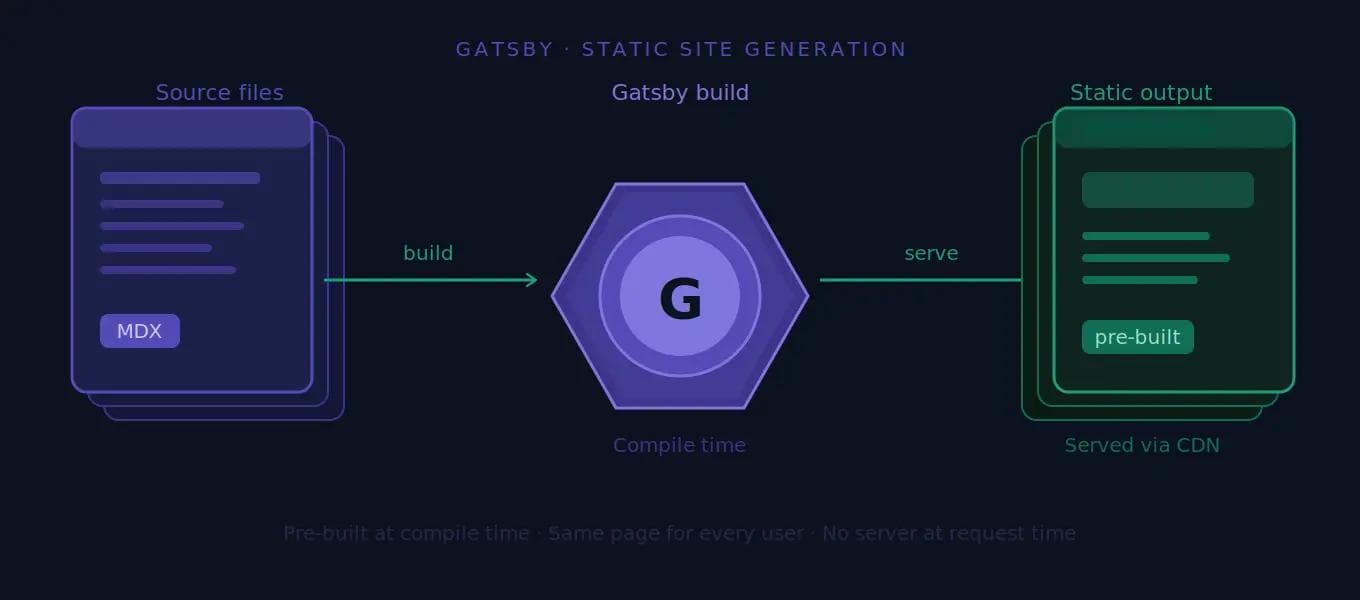
When you build a Gatsby site, it transforms the entire site into static HTML files hosted at your provider. That pre-built output is what makes Gatsby fast: there is no server processing at request time.
What is Next.js?
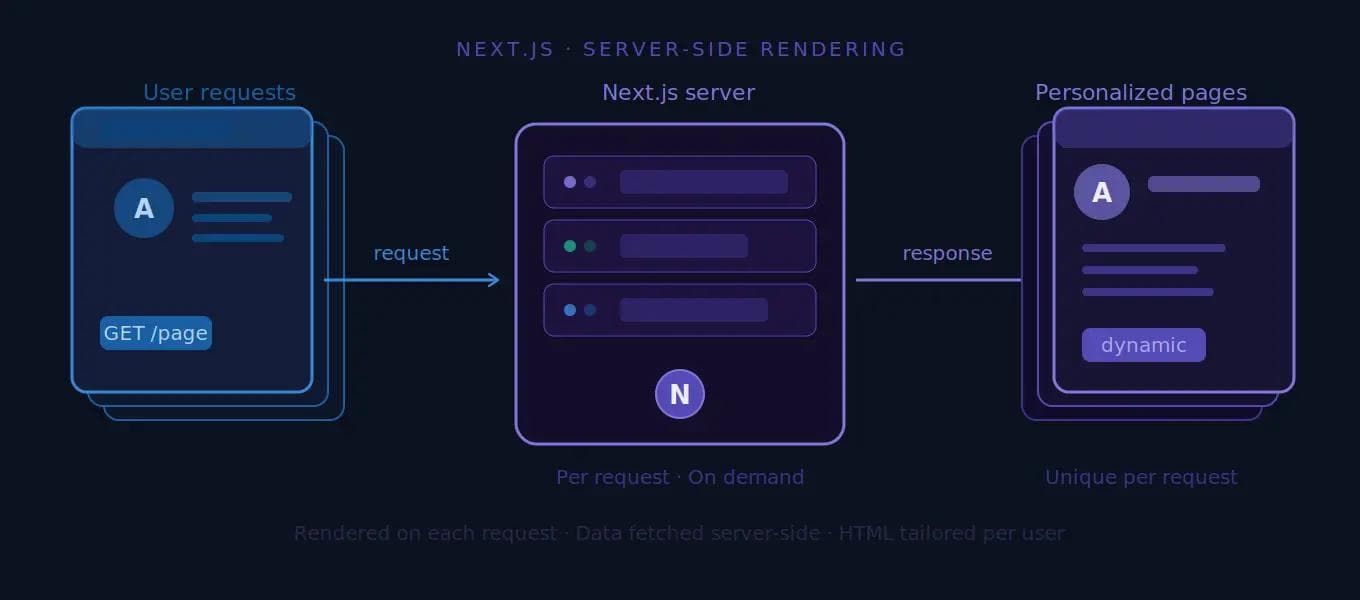
Next.js is a JavaScript framework for building fast, user-friendly websites with server-side rendering (SSR). Rather than generating pages at build time, it generates HTML dynamically on a server for each request.
How does Next.js work?
Next.js provides server-side rendering of React components out of the box. Developers render JavaScript on the server and send indexable HTML to the user, combining the SEO (Search Engine Optimization) benefits of static HTML with the flexibility of dynamic data.
Next.js uses automatic code-splitting, hot reloading, and single-file components. These features help developers build React websites that are flexible and maintainable at scale.
Gatsby vs. Next.js: How they compare
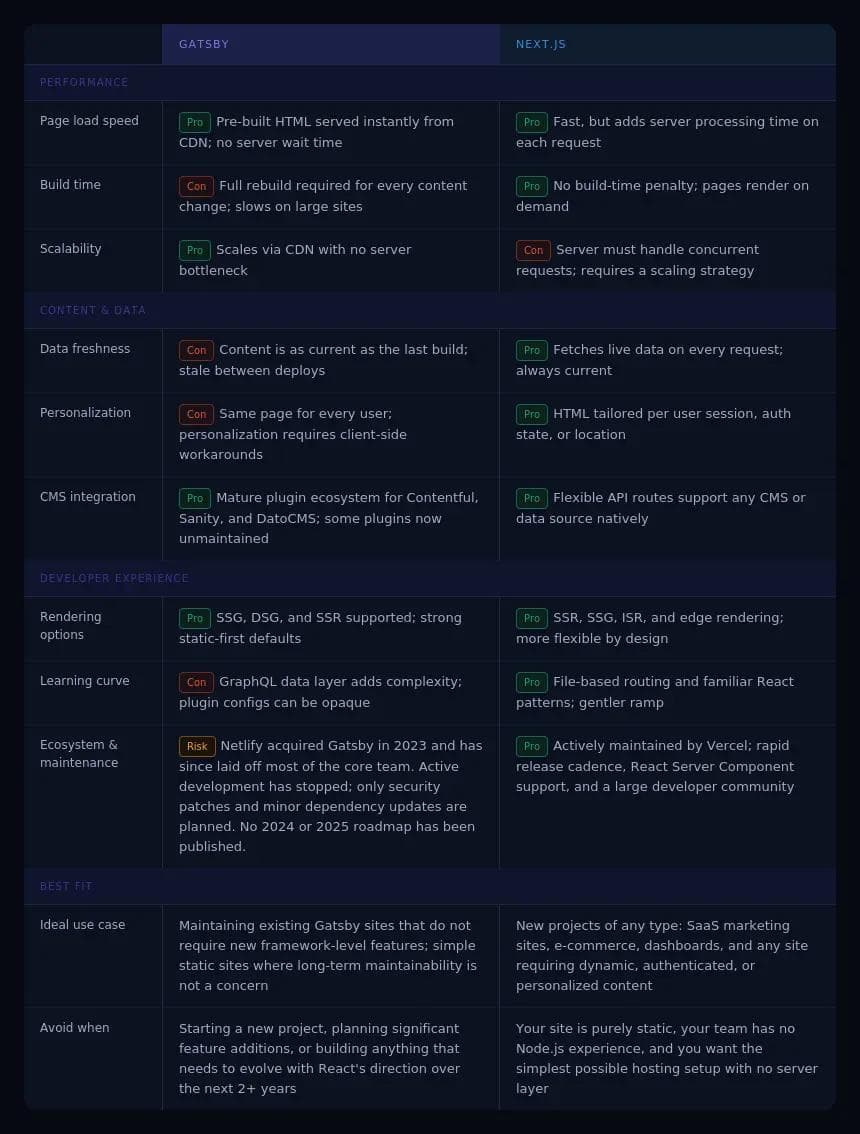
The right choice depends on your team's operating model, content velocity, and long-term architecture needs. Those factors have always mattered. What matters more now is a factor the old comparison rarely had to address: Gatsby's active development has effectively stopped.
What Gatsby still does well
Gatsby remains a capable framework for existing projects and narrow use cases. Teams already running Gatsby sites do not need to migrate immediately. The framework is stable, and sites built on it will continue to perform.
For new projects, Gatsby's rendering options remain technically sound:
- SSG: Pre-renders HTML, CSS, and JavaScript pages at build time for fast delivery via CDN.
- DSG (Deferred Static Generation): Builds pages only when first requested, reducing build time on large sites.
- SSR: Renders pages at runtime so visitors see current content.
Gatsby also has a mature plugin ecosystem, including well-maintained integrations for Contentful and Sanity that can still accelerate headless CMS implementations. For an example, see the available Contentful plugins.
The important caveat: Netlify has confirmed it is no longer investing in new Gatsby features. Several plugins, including key third-party integrations, have gone unmaintained. Teams choosing Gatsby for a new project should factor in that they are building on a framework with no active roadmap.
What Next.js excels at
Next.js is the clear choice for teams starting new projects. Backed by Vercel and under active development, it continues to add capabilities that Gatsby has not and will not match.
Key advantages include:
- Flexible rendering: SSR, SSG, Incremental Static Regeneration (ISR), and edge rendering are all supported natively.
- Reusable components: A smooth development process with component reuse that reduces redundancy and cuts development time.
- Built-in optimization: Automatic image optimization and CSS support are included without additional plugins.
- React Server Components: Next.js introduced server component support ahead of Gatsby and continues to align closely with React's own direction.
For teams adopting MACH (Microservices, API-first, Cloud-native, Headless) architecture principles, Next.js's flexibility matters. It supports architectures where rendering strategy, content systems, and integrations must evolve as the website grows, without waiting for framework updates that may not arrive.
When to use each framework
Knowing what each framework does well is only half the decision. The other half is matching those strengths to your team's specific situation: the type of site you are building, how often it needs to change, and how long you need the architecture to hold up. The two scenarios below cover the most common paths teams face today.
Gatsby: suitable for existing projects and static-only builds
Gatsby is still a reasonable choice in two specific situations: maintaining an existing Gatsby site that does not require new framework-level features, or building a small, simple static site where long-term maintainability is not a concern.
Static sites pair naturally with a headless CMS. Gatsby's GraphQL data layer and plugin ecosystem still support that pattern well. If you're planning a migration to headless and are evaluating frameworks, however, Next.js is the more defensible long-term foundation.
Next.js: the default choice for new projects
Next.js is the right starting point for any team building net-new. It handles the SSR use cases that dynamic, multi-user sites require: different users can access different features simultaneously without the build-time bottleneck that limits purely static approaches.
Next.js can also generate static sites. Teams that want SSG performance with the option to add dynamic rendering later do not have to choose upfront. That flexibility, combined with active framework support, is why Next.js has become the default for B2B SaaS websites, e-commerce, and content-heavy marketing sites that need to evolve.
The verdict
For new projects, Next.js is the clear recommendation. Gatsby's technical capabilities are sound, but a framework without active development is a liability for teams that need to scale, integrate new tooling, or keep pace with React's evolution. The maintenance risk alone is reason enough to default to Next.js.
For teams already on Gatsby, the right move depends on how much active development the site requires. A stable marketing site with infrequent updates can stay on Gatsby without immediate risk. A site that needs frequent feature additions, new CMS integrations, or deeper personalization should plan a migration.
At Webstacks, we evaluate frameworks in the context of how a website will need to evolve over time, not just how it performs at launch. The framework decision is one input into a larger architecture question: does this site have the right foundation to support ongoing iteration, new integrations, and team autonomy without a full rebuild every 18 months?
Whether you are evaluating Next.js for a new build or assessing whether a Gatsby migration makes sense, talk to Webstacks. We help B2B teams make the right call before the architecture is locked in.

Your website is your biggest growth lever—are you getting the most out of it? Schedule a strategy call with Webstacks to uncover conversion roadblocks, explore high-impact improvements, and see how our team can help you accelerate growth.